- Common OAuth Authentication Error
- How to Fix OAuth Authentication Errors
- What Does the 401 Unauthorized OAuth Error Mean?
- Check Your Google API Configuration
- Google API quota errors
- When Should You Contact GSheetConnector Support?
- Frequently Asked Questions About OAuth Authentication
- Connect WordPress Data to Google Sheets with GSheetConnector
Resolving OAuth Authentication Errors: A Step-by-Step Guide


If you’re seeing an OAuth authentication error in GSheetConnector, your Google account email isn’t displaying correctly, or your logs show a 401 Unauthorized or UNAUTHENTICATED error, the Google authentication connection may need to be refreshed.
These errors can happen when the required Google permissions were not granted, an authentication code was not saved correctly, or an existing OAuth credential is no longer valid.
In this guide, we’ll explain the most common Google OAuth authentication errors in GSheetConnector and show you how to troubleshoot and resolve them step by step.
Common OAuth Authentication Error
When trying to authenticate your Google account from the GSheetConnector Integration tab, you may see the following message:
“Something went wrong! Your Auth Code may be wrong or expired. Please Deactivate AUTH and Re-Authenticate again.”
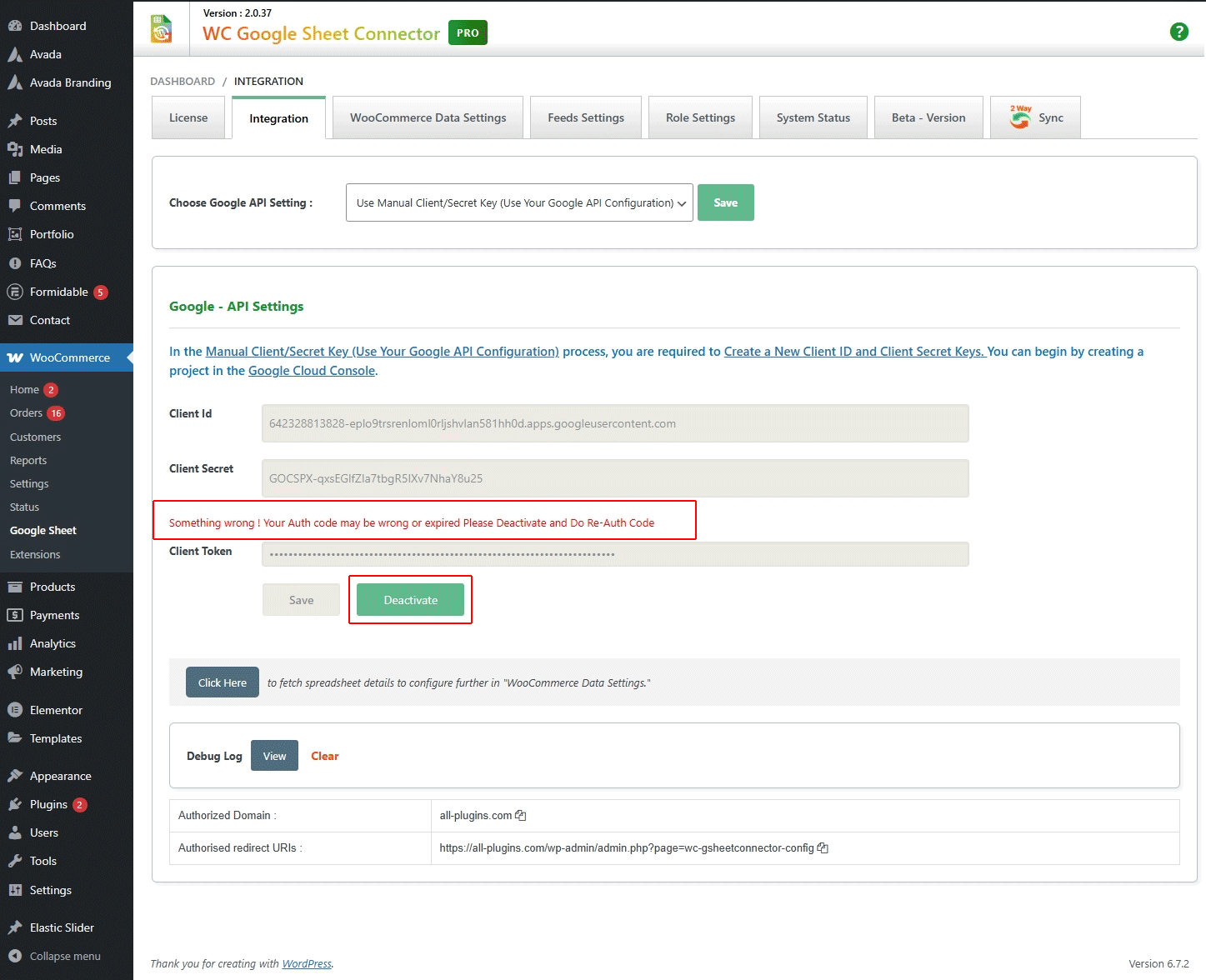
This OAuth authentication error usually occurs when the required permissions for Google Drive and Google Sheets were not granted during authentication or when the authentication code was not saved correctly.
If your Google email is also missing from the Integration tab, re-authenticating the connection is usually the best place to start.
How to Fix OAuth Authentication Errors
Follow these steps in order to troubleshoot the Google authentication problem in GSheetConnector.
1. Check Google Sheets and Google Drive Permissions
GSheetConnector needs the appropriate Google permissions to communicate with your Google account and work with your spreadsheets.
During the authentication process, make sure you grant access to:
* Google Sheets
* Google Drive
If you’re using the Manual Authentication Method, check your Google API configuration and make sure the required APIs and credentials are configured correctly.
You can review your Google API configuration using the Google API Console
You can also check your Google Account’s connected applications and review the permissions granted to GSheetConnector under your Google Account Security Settings.
If a required permission was previously denied, the existing authorization may need to be removed before authenticating again.
For detailed instructions, see the GSheetConnector guide on Google Sheet API Settings.
2. Deactivate AUTH and Re-Authenticate
If the required permissions are already granted but you’re still seeing an OAuth authentication error, create a fresh authentication connection.
Go to the Integration tab in your GSheetConnector plugin and:
1. Click Deactivate AUTH.
2. Follow the prompts to remove the existing authentication.
3. Start the Google authentication process again.
4. Sign in with the Google account you want to connect.
5. Grant all requested permissions.
6. Complete the authentication process.
7. Return to the GSheetConnector Integration settings.
Re-authentication can resolve problems caused by an invalid, expired, or incomplete OAuth authorization.
3. Save the Authentication Code
After completing the Google authentication process, make sure you save the authentication code.
This step is easy to overlook, but the authentication information needs to be saved successfully for GSheetConnector to use it for subsequent requests.
After re-authenticating:
1. Enter or confirm the authentication code.
2. Click Save.
3. Wait for the authentication process to complete.
4. Refresh the Integration settings.
5. Check whether your Google account email is now displayed correctly.
If you complete the Google authorization but do not save the authentication information, the connection may continue to fail.
What If the OAuth Email Is Not Displaying?
One common symptom of an unsuccessful Google authentication is that the OAuth email address does not appear correctly in the GSheetConnector Integration tab.
If this happens, try the following:
1. Deactivate the existing AUTH connection.
2. Re-authenticate with the correct Google account.
3. Grant Google Sheets and Google Drive permissions.
4. Save the authentication information.
5. Refresh the Integration tab.
6. Check whether the Google email address is displayed.
If the email is still missing, enable debugging and check the log for authentication or API errors.
Also make sure you’re authenticating with the Google account that has access to the spreadsheet you want GSheetConnector to use.
4. Enable Debug Mode and Check the Logs
If the OAuth problem continues after re-authentication, the debug log can help identify what is actually failing.
Enable debug mode in the relevant GSheetConnector settings and review the generated log for messages related to:
* OAuth
* Authentication
* Unauthorized requests
* Access tokens
* Permissions
* Google API requests
* `401`
* `UNAUTHENTICATED`
For more information about using the debug log, see the GSheetConnector Debug Log.
Example of a 401 OAuth Authentication Error
You may see an error similar to the following in the log:
Log created at 2024-xx-xx 15:44:37
PHP 8.1.27
gsheet_get_google_account Error in fetching user info:
{
"error": {
"code": 401,
"message": "Request is missing required authentication credential. Expected OAuth 2 access token, login cookie or other valid authentication credential. See https://developers.google.com/identity/sign-in/web/devconsole-project.",
"errors": [
{
"message": "Request is missing required authentication credential. Expected OAuth 2 access token, login cookie or other valid authentication credential. See https://developers.google.com/identity/sign-in/web/devconsole-project.",
"domain": "global",
"reason": "unauthorized"
}
],
"status": "UNAUTHENTICATED"
}
}
What Does the 401 Unauthorized OAuth Error Mean?
A 401 Unauthorized or UNAUTHENTICATED error means that the request sent to Google did not contain a valid authentication credential.
In this case, GSheetConnector is attempting to retrieve information from Google, but the required OAuth credential is missing or cannot be used.
The error specifically refers to an expected OAuth 2 access token or another valid authentication credential.
If you see this error, the first things to check are:
* Whether the Google account is still authenticated.
* Whether the required permissions were granted.
* Whether the authentication code was saved.
* Whether the Google account needs to be re-authenticated.
* Whether your Google API configuration is correct when using manual authentication.
Re-authenticating the Google account is therefore an important first troubleshooting step.
Check Your Google API Configuration
If you’re using the Manual Authentication Method, check your Google Cloud/API configuration as well.
Make sure your Google project is configured correctly and that the required APIs, OAuth credentials, and permissions are in place.
You can follow our Google Sheet API Settings guide for instructions on creating and configuring the required Google API credentials.
This is especially important if you recently:
* Created a new Google Cloud project.
* Changed OAuth credentials.
* Changed the OAuth consent configuration.
* Changed the authorized account.
* Migrated to a different authentication method.
* Reconfigured the Google Sheets API.
OAuth Authentication Error vs. Google Quota Error
Not every Google API error is an OAuth problem.
It’s important to distinguish between an authentication error and a Google API quota or rate-limit error.
OAuth authentication errors
Authentication problems commonly appear as:
* `401 Unauthorized`
* `UNAUTHENTICATED`
* Missing authentication credentials
* Invalid authentication credentials
* Authentication or authorization failures
These errors generally require you to check the Google authentication connection, permissions, or API credentials.
Google API quota errors
Quota-related problems are different. They can occur when API usage reaches Google’s applicable limits.
If your logs show quota-related errors rather than a `401` authentication error, re-authenticating your Google account may not solve the problem.
For more information, see our guide on How to Fix Missing Entries Caused by Google Quota Limits.
You can also read 5 Easy Steps to Fix the “Google Hasn’t Verified This App” Error if your issue occurs during the Google authorization or verification process.
When Should You Contact GSheetConnector Support?
If you’ve completed the troubleshooting steps above and the OAuth authentication error still appears, our support team can help you investigate the issue.
Before contacting support, collect the following information:
* GSheetConnector plugin name and version
* WordPress version
* PHP version
* Authentication method being used
* Exact error message
* Relevant debug log entries
* Screenshot of the Integration settings, if applicable
You can also review the GSheetConnector Knowledgebase for additional troubleshooting and integration documentation.
Important: Before sharing logs or screenshots, remove passwords, private keys, access tokens, client secrets, or any other sensitive credentials.
Frequently Asked Questions About OAuth Authentication
Why am I getting an OAuth authentication error in GSheetConnector?
An OAuth authentication error usually occurs when the required Google permissions were not granted, the authentication information was not saved correctly, or the existing Google authentication credentials are no longer valid.
How do I fix the “Auth Code may be wrong or expired” error?
Go to the GSheetConnector Integration tab, click Deactivate AUTH, and authenticate your Google account again. Grant the requested Google Sheets and Google Drive permissions, then save the authentication information.
Why is my Google email not showing in GSheetConnector?
The Google authentication process may not have completed successfully. Deactivate the existing authentication, re-authenticate with the correct Google account, grant the required permissions, and save the authentication information again.
What does a 401 Unauthorized error mean?
A `401 Unauthorized` or `UNAUTHENTICATED` error means the Google API request is missing a valid authentication credential. Re-authenticating the connected Google account is a good first troubleshooting step.
Do I need to grant Google Drive and Google Sheets permissions?
Yes. GSheetConnector needs the appropriate Google permissions to access and work with your Google Sheets and related Google Drive resources.
What should I do if re-authentication does not fix the problem?
Enable debug mode and check the GSheetConnector logs for the exact error. If you still cannot identify the problem, contact GSheetConnector Support and include the relevant log details and plugin information.
Is a Google API quota error the same as an OAuth error?
No. OAuth errors are related to authentication or authorization, while quota errors are related to API usage limits. The exact error shown in the debug log can help determine which issue you’re experiencing.
Keep Your Google Sheets Connection Working
OAuth authentication errors can be frustrating, especially when your Google Sheets integration was working previously. In most cases, however, the problem can be resolved by checking permissions, deactivating the existing authentication, re-authenticating the Google account, and saving the authentication information correctly.
If the problem continues, the GSheetConnector debug log is the best place to look for the underlying error.
Once your Google authentication is restored, GSheetConnector can continue syncing your WordPress data with Google Sheets without requiring you to manually export and manage submissions.
Connect WordPress Data to Google Sheets with GSheetConnector
GSheetConnector makes it easy to connect WordPress forms, page builders, and eCommerce data with Google Sheets.
Explore the GSheetConnector integrations:
- Contact Form 7 Google Sheet Connector
- WP Forms Google Sheet Connector
- Gravity Forms Google Sheet Connector
- Ninja Forms Google Sheet Connector
- Forminator Google Sheet Connector
- Formidable Forms Google Sheet Connector
- Avada Forms Google Sheet Connector
- Divi Forms Google Sheet Connector
- Elementor Forms Google Sheet Connector
- WooCommerce Google Sheet Connector
- Easy Digital Downloads Google Sheet Connector
With GSheetConnector, you can connect your WordPress data to Google Sheets and keep your information organized and accessible without relying on manual exports.