- What's the Real Difference Between GSheetConnector and a Custom Google Sheets API Build?
- What Is a Custom Google Sheets API Integration?
- How Much Does a GSheetConnector Cost?
- How Much Does a Custom Google Sheets API Integration Actually Cost?
- How Do GSheetConnector and a Custom Build Compare on Total Cost?
- Which Option Takes Less Time to Set Up?
- What Are the Ongoing Maintenance Differences?
- When Is a Custom Google Sheets API Integration Better?
- When Is GSheetConnector Better?
- GSheetConnector vs Custom Google Sheets API – Full Comparison
- Frequently Asked Questions
- GSheetConnector vs Custom Google Sheets API – Final Verdict
GSheetConnector vs Custom Google Sheets API – Full Comparison

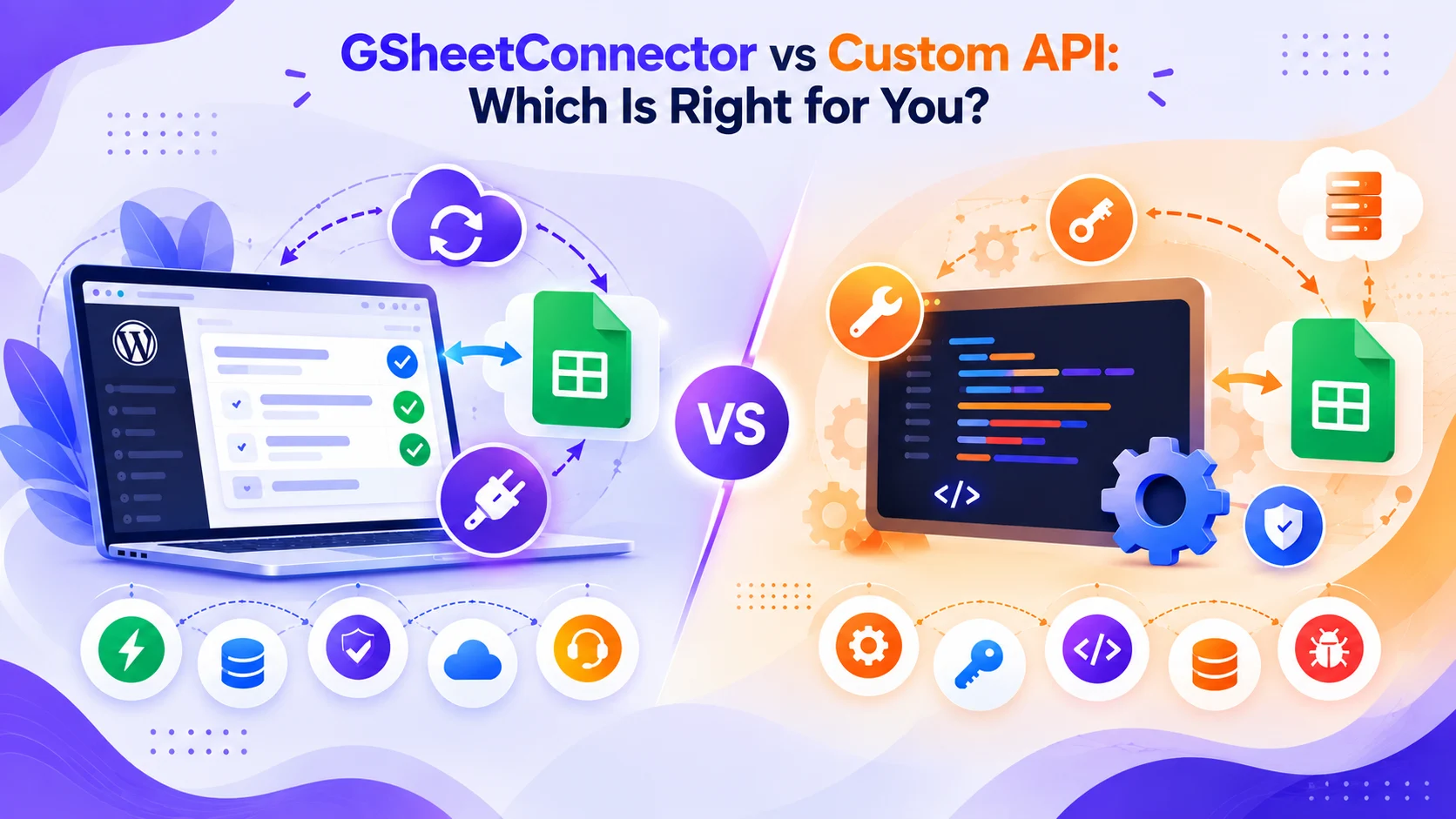
Want WordPress form data in Google Sheets? GSheetConnector makes it easy to connect WordPress with Google Sheets without writing custom API code. But is a ready-made plugin always the right choice, or should you build a custom Google Sheets API integration?
This guide compares GSheetConnector with a custom Google Sheets API integration across cost, setup time, development effort, flexibility, maintenance, and long-term ownership. By the end, you will know which approach makes more sense for your WordPress website.
GSheetConnector seamlessly connects WordPress with Google Sheets to automate data synchronization across a wide range of WordPress platforms. It supports popular contact form plugins such as Contact Form 7 (CF7), WPForms, Gravity Forms, Ninja Forms, Forminator, Fluent Forms, Formidable Forms, Caldera Forms, and JetFormBuilder; page builders and form solutions such as Elementor Forms, Divi Forms, and Avada Forms; eCommerce platforms including WooCommerce and Easy Digital Downloads (EDD); and WordPress Core.
You can explore the free GSheetConnector plugins on WordPress.org or browse the GSheetConnector Add-ons for premium integrations and additional features.
What's the Real Difference Between GSheetConnector and a Custom Google Sheets API Build?
GSheetConnector is a ready-made WordPress plugin that connects WordPress forms and other website data to Google Sheets without requiring you to build the integration from scratch. A custom Google Sheets API integration, on the other hand, requires a developer to write code specifically for your website, application, or workflow.
The Google Sheets API provides the underlying developer interface for reading and writing spreadsheet data. It does not, by itself, provide a complete WordPress integration. A custom solution therefore requires additional development for authentication, data mapping, API requests, error handling, testing, and ongoing maintenance.
The key difference between the two approaches comes down to development effort, setup time, flexibility, maintenance, and cost.
GSheetConnector provides a ready-made solution for common WordPress-to-Google-Sheets workflows. A custom integration provides greater control over the implementation, but your team becomes responsible for building and maintaining the code.
What Is a Custom Google Sheets API Integration?
A custom Google Sheets API integration is software developed specifically to send or retrieve data from Google Sheets using Google's API.
For example, a developer could create a custom workflow such as:
WordPress form → custom PHP code → Google Sheets API → Google Sheet
The developer controls how the data is collected, transformed, authenticated, validated, and written to the spreadsheet.
This approach can be useful when you have highly specialized requirements that a standard WordPress plugin cannot support. However, the development team is also responsible for authentication, error handling, API quotas, security, testing, compatibility, and future changes.
How Much Does a GSheetConnector Cost?
GSheetConnector offers free and Pro options, including annual, lifetime, and agency licensing options depending on the integration. Pro licenses include plugin updates, compatibility updates, and support during the applicable license period. You can view the current options on the GSheetConnector pricing page.
One advantage of this model is cost predictability. Instead of paying a developer to build and maintain a custom integration, you purchase a plugin license and use the functionality provided by the product.
GSheetConnector also maintains its integrations as WordPress, PHP, and Google API requirements evolve, reducing the amount of compatibility work that individual website owners need to manage themselves.
How Much Does a Custom Google Sheets API Integration Actually Cost?
The cost of a custom Google Sheets API integration varies considerably depending on the requirements. A simple WordPress form integration may require relatively little development, while a complex workflow involving multiple systems, custom business logic, authentication, logging, retries, and scheduled synchronization can require substantially more development time.
The initial development quote is only one part of the total cost. You should also consider testing, troubleshooting, future compatibility work, security updates, and developer time required after launch.
Where Do the Additional Costs Come From?
Custom integrations can create additional development work in several areas:
- Google OAuth and app configuration: Depending on the authentication flow, requested scopes, and how the application is used, Google may require additional OAuth configuration or verification. Developers are responsible for configuring and maintaining the relevant Google Cloud project and authentication flow. See Google's OAuth App Verification documentation for the current requirements.
- API quota and error handling: Google Sheets API requests are subject to usage limits. The current documentation lists per-minute quotas, including 300 read requests and 300 write requests per project, with 60 requests per minute per user per project. A custom integration should account for these limits and implement appropriate retry, backoff, batching, or other handling where necessary. How to Fix Google Sheets API Quota Limit Errors. See the official Google Sheets API usage limits.
- Ongoing maintenance: WordPress and PHP versions change, dependencies can be updated, Google APIs can evolve, and custom code may need to be modified or retested. With a custom integration, your team or development partner is responsible for maintaining the implementation.
- Testing and troubleshooting: Custom integrations need to be tested against real-world scenarios such as failed requests, authentication problems, invalid data, API errors, duplicate submissions, and changes to the WordPress environment.
As a result, the initial development cost does not always represent the total cost of ownership. The long-term cost depends on how complex the integration is and how much maintenance it requires.
How Do GSheetConnector and a Custom Build Compare on Total Cost?
A WordPress Google Sheets plugin versus a custom API integration should be evaluated based on total cost, not just the initial setup price.
With GSheetConnector, you pay for a license and receive the functionality, updates, and support associated with that license. With a custom integration, you pay for development and may need to pay additional developer hours whenever the integration needs changes, fixes, or compatibility updates.
| Cost Factor | GSheetConnector | Custom Google Sheets API |
|---|---|---|
| Cost model | Plugin license | Development fee plus ongoing developer costs |
| Upfront development | No custom development required for supported integrations | Developer required to build the integration |
| Setup cost | Generally lower for supported WordPress workflows | Depends on development complexity |
| Maintenance | Plugin updates and support included according to the license | Website owner or development team is responsible |
| Cost predictability | More predictable based on the selected license | Can vary with future development and maintenance requirements |
| Customization | Limited to supported plugin functionality | Highly customizable |
For standard WordPress-to-Google-Sheets workflows, a ready-made plugin can reduce development work and make costs easier to plan. A custom integration can provide more flexibility, but that flexibility comes with additional development responsibility.
Which Option Takes Less Time to Set Up?
For supported WordPress integrations, GSheetConnector can significantly reduce setup time because the core connection and integration functionality are already developed.
A typical setup involves:
- Install the appropriate GSheetConnector plugin.
- Connect your Google account.
- Select or create a Google Sheet.
- Map your WordPress fields to spreadsheet columns.
- Submit a test entry and verify the data.
Depending on the integration and configuration, a basic setup can often be completed in approximately 15–30 minutes. The GSheetConnector documentation provides setup instructions for individual integrations.
A custom API integration generally takes longer because a developer must implement and test the authentication, API communication, data mapping, error handling, and other required functionality.
What Are the Ongoing Maintenance Differences?
Maintenance is one of the biggest differences between a ready-made plugin and custom development.
With GSheetConnector, compatibility work is handled through plugin updates and support according to the applicable license. The plugin is maintained for its supported WordPress integrations as WordPress, PHP, and Google API requirements change.
With a custom integration, your team or development partner must monitor the implementation, troubleshoot failures, update dependencies or API-related code when necessary, and retest the integration after significant WordPress, PHP, or application changes.
In other words, GSheetConnector shifts much of the integration maintenance responsibility to the plugin provider, while a custom API build leaves that responsibility with the website owner or development team.
When Is a Custom Google Sheets API Integration Better?
A custom Google Sheets API integration can be the better choice when you need functionality that goes beyond what a WordPress plugin provides.
Consider a custom solution if:
- You need highly specialized data-processing or transformation logic.
- You need to connect several non-WordPress systems.
- Your application is not based on WordPress.
- You need complete control over API requests and data processing.
- You need a highly customized workflow that existing plugins cannot support.
- You already have an in-house development team responsible for maintaining the application.
- You need custom authentication, logging, scheduling, or business rules.
The main advantage of custom development is flexibility. You can design the integration around your exact technical and business requirements.
When Is GSheetConnector Better?
GSheetConnector is generally a better fit when you are using WordPress and want a ready-made solution for supported integrations.
Consider GSheetConnector if:
- You use WordPress and want to connect website data to Google Sheets.
- You want to connect contact forms such as WPForms, Contact Form 7, Gravity Forms, or other supported form plugins.
- You want to sync WooCommerce data with Google Sheets.
- You want to avoid developing custom API code.
- You want a faster implementation.
- You want plugin updates and integration maintenance handled by the plugin provider.
- Non-developers need to configure and manage the integration.
For example, the WPForms Google Sheet Connector provides field mapping, multiple feeds, conditional logic, Google authentication, and other functionality without requiring you to develop the integration yourself.
GSheetConnector vs Custom Google Sheets API – Full Comparison
| Factor | Custom Google Sheets API | GSheetConnector |
|---|---|---|
| Upfront cost | Development cost depends on project complexity | Plugin license |
| Setup time | Usually longer because development is required | Typically much faster for supported integrations |
| Coding required | Yes | No custom coding required for supported workflows |
| Authentication | Developer responsibility | Built into the plugin's supported connection methods |
| API quota handling | Must be implemented by the developer | Handled by the plugin's integration code |
| Maintenance | Website owner or development team | Plugin provider maintains the integration according to the license |
| Customization | Very high | Based on supported plugin features |
| Best fit | Specialized workflows and non-WordPress applications | WordPress forms, WooCommerce, and supported WordPress data sources |
| Non-developer friendly | Depends on whether a custom admin interface is developed | Yes, through the plugin settings |
The main difference is how much technical responsibility you want to take on.
A custom integration gives you control over the code and can be tailored to almost any requirement. However, your team is responsible for development, testing, security, API handling, troubleshooting, and ongoing maintenance.
GSheetConnector takes a ready-made approach. For supported WordPress integrations, you can configure the connection through the plugin rather than developing and maintaining the integration yourself.
Frequently Asked Questions
1) What is the difference between GSheetConnector and the Google Sheets API?
GSheetConnector is a ready-made WordPress plugin that provides a user-friendly way to connect supported WordPress data sources with Google Sheets. The Google Sheets API is a developer API that allows applications to read and write spreadsheet data.
With a custom API approach, developers need to build the authentication, data mapping, API communication, error handling, and application-specific logic themselves.
2) How do I connect a WordPress form to Google Sheets?
You can connect a WordPress form to Google Sheets using GSheetConnector or by developing a custom Google Sheets API integration.
With GSheetConnector, you install the appropriate integration, connect your Google account, select or create a spreadsheet, map your fields, and test a submission. A custom implementation requires development for authentication, data mapping, API communication, and error handling.
3) How long does it take to connect WordPress to Google Sheets?
A ready-made plugin can significantly reduce setup time. For supported GSheetConnector integrations, the basic configuration can often be completed in around 15–30 minutes, depending on the WordPress plugin and workflow.
A custom integration can take considerably longer because it requires coding, authentication, testing, error handling, and deployment.
4) Can I connect WooCommerce data to Google Sheets?
Yes. WooCommerce data can be connected to Google Sheets using an integration plugin or a custom Google Sheets API implementation.
The WooCommerce Google Sheet Connector can sync supported WooCommerce data such as orders, products, customers, coupons, and other information to Google Sheets. A custom API implementation provides more control when you need specialized data processing or workflows.
5) Does a custom Google Sheets API integration require ongoing maintenance?
Generally, yes. A custom integration may require maintenance when WordPress, PHP, dependencies, Google APIs, authentication requirements, or your own application requirements change.
The website owner or development team is responsible for monitoring and maintaining the custom implementation unless maintenance has been separately outsourced.
6) Is a custom Google Sheets API integration better than a plugin?
Not necessarily. A custom integration provides greater flexibility and control, while a plugin can significantly reduce development time and ongoing maintenance for supported WordPress workflows.
The better option depends on your requirements. If you need a specialized workflow or a non-WordPress application, custom development may be appropriate. If you need a standard WordPress-to-Google-Sheets integration, a ready-made plugin can be faster and easier to maintain.
7) Can I switch from a custom Google Sheets API integration to GSheetConnector?
In many cases, yes, provided that the existing workflow uses functionality supported by GSheetConnector. Before migrating, review your current data mapping, authentication method, triggers, spreadsheet structure, and any custom business logic.
If your custom integration performs specialized processing that is not supported by the plugin, some custom development may still be required.
8) Which option should you choose for Google Sheets and WordPress?
For most standard WordPress-to-Google-Sheets workflows, GSheetConnector is a practical choice when you want to reduce development time and ongoing maintenance.
Choose a custom Google Sheets API integration when you need highly specialized functionality, a non-WordPress application, or complete control over the implementation.
GSheetConnector vs Custom Google Sheets API – Final Verdict
There is no single solution that is best for every project.
Choose GSheetConnector if you use WordPress and want a faster, ready-made way to connect supported forms, WooCommerce, and other WordPress data to Google Sheets without developing and maintaining the integration yourself.
Choose a custom Google Sheets API integration if you need highly specialized data processing, a non-WordPress application, or complete control over the integration's code and architecture.
For a standard WordPress-to-Google-Sheets workflow, starting with GSheetConnector can help you validate your requirements without committing to a custom development project. You can explore the available GSheetConnector integrations or start with a free version to see whether it meets your needs.
If your requirements go beyond what the plugin supports, a custom Google Sheets API integration remains a powerful option for building a solution around your exact workflow.